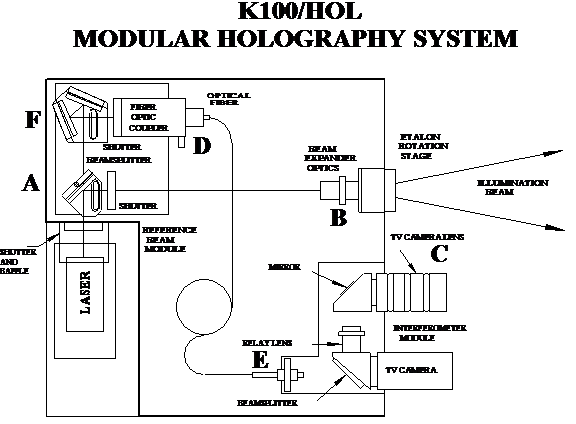
Figure 1.
Figure 1 above
illustrates the modular design of the Electronic Holography optical head
mounted on an 18-inch square pallet. It
is composed of 3 modules: an interferometer module, a beamsplitter module,
and an illumination module, which can be attached to the beamsplitter module to
form a single unit. The interferometer
and beamsplitter modules are connected by a polarization preserving optical
fiber that provides the reference beam for the interferometer. This is greatly superior to a reference beam
propagating in free space because it provides stable alignment.
The design of the interferometer module
eliminates problems found in most competing designs. First, the beamsplitter is approximately 90%
reflective and oriented so that the image forming rays never pass through
it. That orientation eliminates image
aberrations and also eliminates patterns in the reference beam from reflections
by the second surface. The primary
image-forming lens is a standard TV zoom lens on a standard C-mount. This is followed by a field lens and a
high-quality relay lens to bring the image to the TV camera with no vignetting
or aberrations. The imaging lens is
mounted on a translation stage to facilitate focusing.
The beamsplitter module also uses a high
reflection beamsplitter to direct the majority of the laser light to the
object. The remainder is reflected by two piezo-electrically actuated mirrors
to the fiber optic coupler. Two compact
rotary shutters are incorporated to switch the illumination and reference beams
on and off independently. During the
calibration, the interferometry program measures the ratio of the object beam
to reference beam at the TV camera. The beam
ratio can be adjusted over a wide range by defocusing the reference beam on the
end of the optical fiber.
The
illumination module consists of a pair of lenses, one stationary and one
movable along its axis, which can expand or compress the illumination beam over
a wide range. An anamorphic prism beam
expander is also available to elongate the profile of the beam to provide
uniform illumination of oblong-shaped objects.
The illumination beam also passes through a tilted etalon that shifts
the beam laterally without changing its direction of propagation. When this assembly rotates, the speckles on the object seen by the TV camera change, and this is
used to eliminate speckles by averaging.
The layout of the K100/HOL optical head is
simple and provides easy access to all adjustments. The protective cover is a set of sides that
bolts to the pallet capped with a hinged lid so that the user has instant and
easy access to any necessary adjustment.
An interlock switch is installed to shut off the laser if an
unauthorized person opens the lid.